Technology
- Home
-
Technology
Technology
DMG® Technology by Powerhouse Energy
Distributed Modular Generation (DMG®) is an advanced and innovative platform designed for the conversion of non-recyclable waste plastics into clean energy. This cutting-edge technology regenerates plastic waste into power or hydrogen, providing a sustainable energy solution for transport, industrial applications, and the chemical and plastics industries.
Developed by Powerhouse Energy, DMG® represents a breakthrough in waste-to-energy technology, offering an efficient and environmentally responsible alternative for tackling plastic waste while supporting the transition to clean energy.
Powerhouse Energy Group plc is a publicly traded company listed on the London Stock Exchange’s AIM market under the ticker symbol PHE.
Process
How the process works
Feedstock
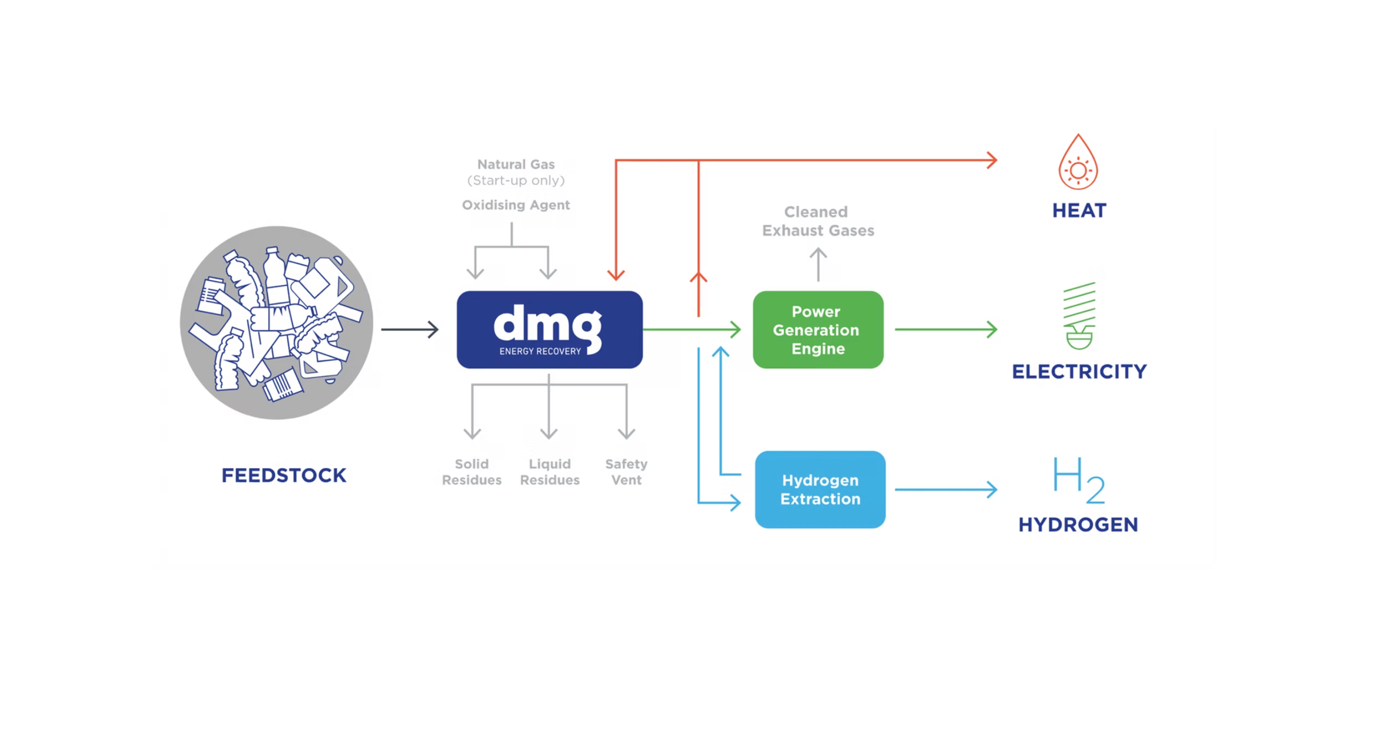
Waste plastic is shredded then separated into recyclables and non-recyclable feedstock. Feedstock can be shred, powder, dust or slurry. The process can deal with unrecyclable, mixed, sorted and contaminated plastics
Deoxidising
Non-recyclable feedstock is passed through a vacuum controlled bin feed system to remove excess air

Gasification
Air-free feedstock moves through the rotating ultra-high temperature thermal conversion chamber at atmospheric pressure, in a non-combusting environment. Converting it into EcoSynthesis gas

Disposal of by-product
The EcoSynthesis gas passes out of the reactor and any remaining, inert solids are disposed of according to local environmental standards

Syngas Treatment
The syngas is then ‘scrubbed’ twice by a shower of caustic liquid. This removes any impurities from the gas
Syngas Uses
The syngas can then be used by itself or used to immediately to generate electricity in a gas-powered turbine or separated into hydrogen.
Technology
Technology Overview
Feedstock
DMG® is designed to process a diverse range of feedstocks, including various polymer blends, bio-based fuels, and non-recyclable waste plastics. Mixed, unsorted, and contaminated plastics can be efficiently converted into energy-rich syngas through thermal processing, with minimal inert by-products.
Scalable
The technology features a scalable modular design, available in capacities of 2.5 to 40 tonnes per day. With its compact footprint, the system efficiently processes waste while allowing for flexible deployment and expansion
Optimised Multi-End Output
The DMG® technology produces high-purity syngas (>95%), which can serve as a direct substitute for natural gas. Additionally, it can be converted into various energy forms, including electricity, hydrogen, heat, methane, and liquid fuels, enhancing its versatility and sustainability.
Sustainable & Low-Carbon Solution
The DMG® system efficiently processes non-recyclable plastics, converting them into clean energy with a net negative CO₂ footprint. By generating low-carbon hydrogen and minimising emissions, it offers an environmentally responsible alternative to traditional waste disposal and energy production methods.
Efficient & Economical
The system efficiently converts high-calorific-value plastic waste into electricity or hydrogen, maximising energy recovery. Designed for cost-effectiveness, it operates on a small scale while delivering a positive financial yield, making it both an environmentally and economically viable solution.
Expertise
Altec’s expertise enables the efficient utilisation of contaminated, non-recyclable waste while generating a consistent and controllable syngas that has multiple end uses
Technology
History
-
Developed in year 2016 by PHE, the demonstration plant was designed and used for proving the concept of DMG® technology, system completed certification by DNV-GL -
Since 2017, a laboratory scale demonstration unit of the DMG® technology has been operating at the Thornton Science Park in Chester -
Extensive test engineering of a range of plastic feedstocks. The first extended trial produced syngas with over 50% hydrogen content by volume
Technology Centre
The Technical Centre in Bridgend, UK, was completed and became fully operational in February 2025, following successful testing in January. Initial tests on native plastics have yielded positive results, aligning with previous modelling and expectations. The facility benefits from improved temperature control using gas burners, surpassing the performance of the small demonstration unit and enhancing the efficiency of future commercial systems. It serves as a showcase platform for clients, allowing them to test their own waste materials. Additionally, the Syngas produced can be utilized as a feedstock for evaluating downstream equipment and processes.
Applications
Application of DMG® technology
All local municipalities and councils
Industrial estates and industrial H2 users
Marine ports
Recycling plants
Landfill sites
Islands